- Accueil
- > Shakespeare en devenir
- > N°19 — 2025
- > L’Œil du spectateur. Play Reviews
- > If music and dance be the food of drama: Celebrating Twelfth Night at the New Globe
If music and dance be the food of drama: Celebrating Twelfth Night at the New Globe
Dir. Robin Belfield, London 2025
Par Nathalie Robert-Jurado
Publication en ligne le 24 septembre 2026
Résumé
“If music be the food of love, play on!” (I.1). Shakespeare’s Twelfth Night, or What You Will has long been celebrated for its playful engagement with festivity, identity, cross-dressing and gender bending and for its engagement with the expectations of drama. The title itself is an invitation to interpret “Or What You Will,” and to celebrate personal and imaginative experience. In Robin Belfield’s 2025 production at Shakespeare’s Globe, one may witness a real “riotous celebration of life” (The Times), in the midst of a wild festival. This article investigates how Belfield’s performance amplifies these elements through a joyous and colorful use of music and dance that function as dramatic forces. This study will also consider the tension between exuberant performance and a more subtle emotional understanding of Shakespeare’s text, reflecting on how contemporary staging that includes music and dance celebrate drama while engaging with its deeper thematic resonance.
« If music be the food of love, play on! » (I.1). La Nuit des rois de Shakespeare est depuis longtemps célébrée pour son approche ludique de la fête, l’identité, le travestissement, les jeux de genre, ainsi que pour son rapport au théâtre. Le titre lui-même constitue une invitation à interpréter (« Or what you will »), et à célébrer l’expérience personnelle et imaginative. Dans la mise en scène de Belfield en 2025 au Shakespeare’s Globe, le public assiste à une véritable « célébration exubérante de la vie » (The Times), au cœur d’un chaos festif. Cet article interrogera comment Belfield amplifie cette impression par le biais de la musique et de la danse, qui fonctionnent comme des forces dramatiques, et comment la tension entre performance exubérante et une mise en scène contemporaine intégrant musique et danse peut célébrer le théâtre, tout en mobilisant ses résonances thématiques plus profondes.
Mots-Clés
Table des matières
Article au format PDF
If music and dance be the food of drama: Celebrating Twelfth Night at the New Globe (version PDF) (application/pdf – 1,0M)
Texte intégral
1Shakespeare’s Twelfth Night, or What You Will extends an invitation to the audience to interpret, to imagine, and to experience as “we will” or as we wish. Robin Belfield’s 2025 production at the New Globe Theatre, London, embraced such openness by transforming Illyria into a place of bright, musical, interactive and bodily carnival, emphasising festivity and musical engagement. As The Times aptly put it, the performance became a “riotous celebration of life”.1 The play’s themes of festivity, disguise, and mistaken identity have long made it fertile ground for directors to explore the relationship between theatricality and the expression of the self. However, many reviewers have argued that Belfield’s aesthetic exuberance sometimes flattens the play’s melancholy and emotional subtlety, setting the poetical tone aside.
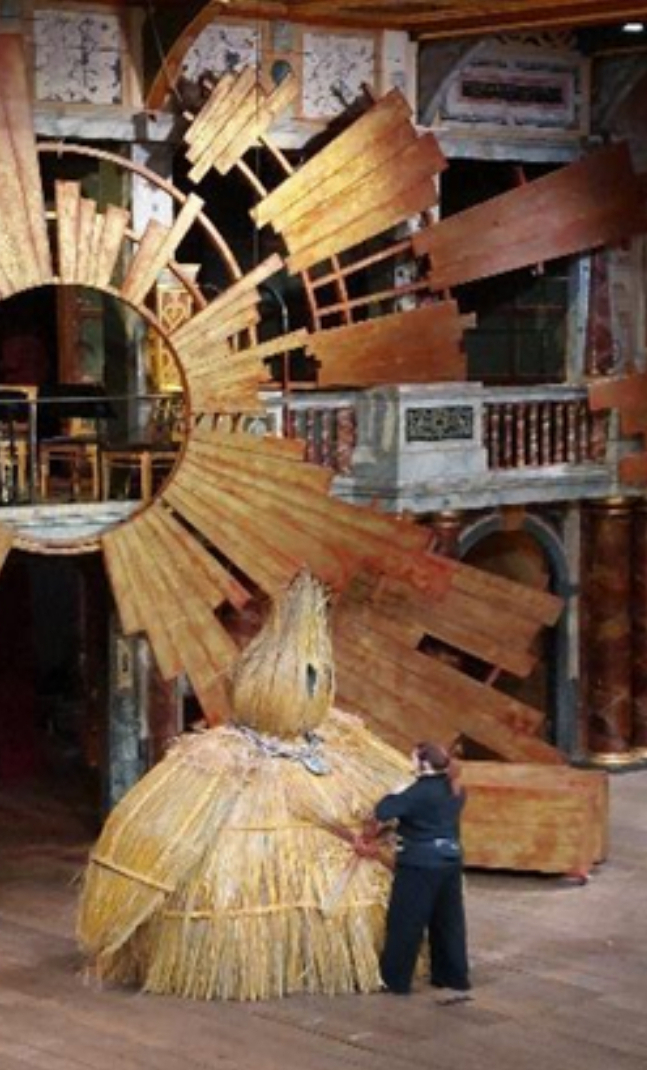
2This play review, based on the performance that took place on October 25th, 2025, at the New Globe Theatre (London, UK), shall explore how stage director Robin Belfield’s Twelfth Night amplified Shakespeare’s playfulness through music and dance as integral dramatic forces that invited the audience into a multi-sensory, participatory experience, while Belfield’s intent was to immerse the audience in a carnival-inflected Illyria. At the same time, this study will consider the tension between an exuberant performance and a more emotional interpretation of Shakespeare’s play and reflect on how Belfield’s contemporary production ‒ that extensively uses music and dance ‒ may celebrate drama without overlooking emotional depth.
Amplifying Shakespeare’s playfulness through music and dance as integral dramatic forces: the carnival of Illyria meant to strengthen audience engagement
3In his introduction to his book Shakespeare’s Festive World, François Laroque refers to the importance of extra-diegetic elements that contribute to creating the atmosphere of playfulness and festivity.2 He reminds his readers that in theatrical events, both royal and civil festivities used to be unavoidably linked to music, dance, movement, colour as well as the frenzy coming from the audience in the background.
4In Belfield’s production, the audience is first attracted to the magnificent golden shimmering sun dominating the open-air stage that emphasised the particularly vivid expression of the stage. Indeed, Robin Belfield’s scenography was designed to provide a stage for dynamic and joyful characters. Then, amongst the audience, Viola (Ronke Adekoluejo) broke the silence of the groundlings and started interrogating: “[w]hat country, friends, is this?” (I.2.21).3 The white-uniformed captain by her side replied: “[t]his is Illyria, lady” with a strong stress on the word “lady”. Thus, the audience was led to immediately witness the shipwreck’s survivor, Viola addressed and defined as “lady”, standing alone on a box representing the shores of Illyria. Note that the other character later referred to as “lady” in the play will be Olivia. By adding and stressing the word “lady”, Viola’s social position on stage and in Illyria is shared with the audience, although this element of dramatic irony will remain secret to all the other characters of the tale. The audience know that Viola and Olivia are mirror characters through their shared identity as women and ladies. Robin Belfield, however, chose not to lay the emphasis on the male characters. As a result, Orsino does not appeared first, despite the fact that the play originally opens with his line “[i]f music be the food of love, play on” (I.1.1). As a matter of fact, Viola’s presence in the pit worked as a prologue to the play. She was dressed in a green and purple gown that resembled Caribbean outfits, with many golden jewels on and long braids that were cut off at the end of the scene. The audience around them acted as visual witnesses to her transformation as though they were also part of the plot and shared the secret of her true identity.

Fig. 1 : Viola (Tonke Adékoluejo) and Sea Captain (Joshua John).
Crédits : Helen Murray.
5The choice of her outfit was a hint at the stage director’s British Bahamian’s origin.4 It was also a possible reminder of the winter Notting Hill Jamaican Carnival for Londoners. In the production, all the characters were dressed in a very multi-coloured way: orange, flashy blue, green dominated the design of costumes, thereby enhancing the carnivalesque feature.
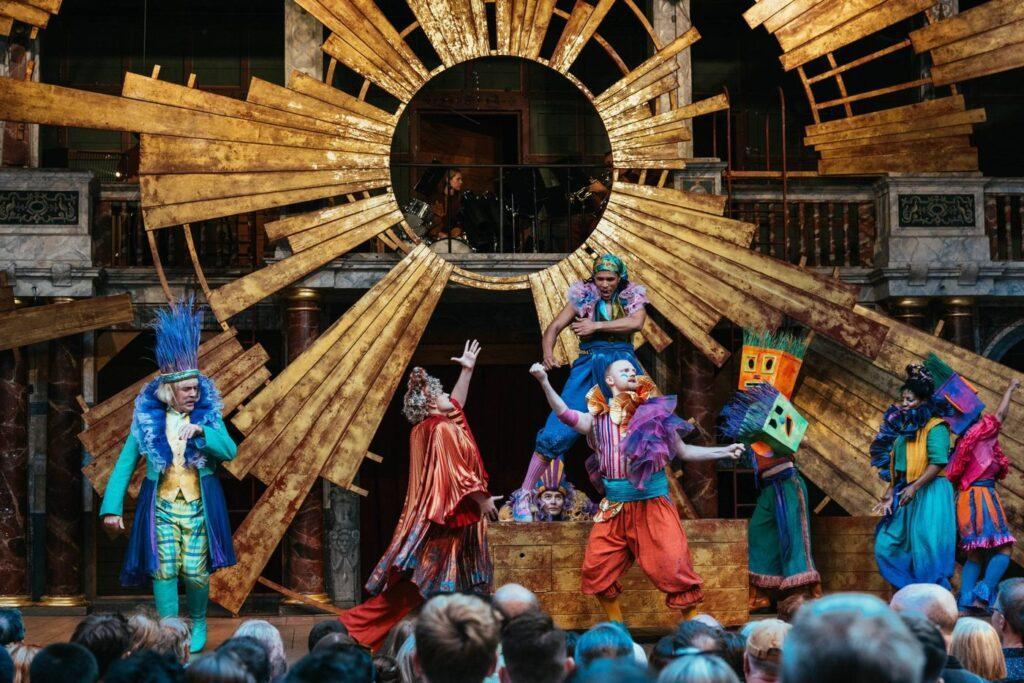
Fig. 2 : Cast members.
Crédits : Helen Murray.
6Music also immediately gave greater importance to Viola’s entrance, thus connecting the audience with the musicians placed centre-stage under the huge golden sun designed by Jean Chan5 that “provide[s] a striking visual centrepiece that looks stunning in the Globe’s open-air setting”.6 This sun-shaped door was used with great efficiency for the entrances and exits of the musicians.7 In 2021, Jean Chan had already designed a glowing stage with bright blue props at the Globe for another Twelfth Night performance directed by Sean Holmes, thus strengthening the vivid carnivalesque atmosphere of the Epiphany.

Fig. 3 : Sean Holmes, Twelfth Night or What You Will, the Globe Theatre, London, 2021.
Crédits : Marc Brenner.
7On Belfield’s stage, just after Viola’s shipwreck, a moment of communion was suggested as ALL the characters came in and danced. Their outfits, also designed by Jean Chan, “[were] integral to evoking the play’s weird world and marking shifts in the characters’ emotional states”.8 Conversely, Malvolio and Olivia were wearing dark clothes, either to represent Olivia’s period of mourning – that ends from Act 4 onwards – or Malvolio’s Puritan looks. These outfits also gave most characters the aspect of circus comedian. This visual contrast contributed to an atmosphere of “oodles of charm and midsummer madness ushering away the play’s darkness”.9 Music was played loud, the audience were clapping and cheering, and all the characters kept on dancing on stage during Viola’s cue-delivery. The musicians engaged with the audience to craft a lively atmosphere that invited the latter to contribute to this festive moment. The carnival of Illyria dominated the stage with the bright green African-Caribbean-like costumes, making this Twelfth Night “a feast for the eyes, with flashes of brilliance in its comedy”.10 Orsino (Solomon Ismaël) appeared in the manner of a magnificent Duke, with a golden headdress and a bright blue long jacket.

Fig. 4 : Duke Orsino (Solomon Ismael).
Crédits : Helen Murray.
8Yet, his vivid visual presence did not echo his verbal presence. He is the third character speaking on stage and delivers only 59 speeches – against 121 for Viola. Maria, who is a secondary character, delivers the same number of speeches as Orsino.
Speeches per act in Shakespeare’s Twelfth Night
|
Character |
Act I |
Act II |
Act III |
Act IV |
Act V |
Total speeches |
|
Orsino |
11 |
13 |
14 |
6 |
9 |
59 |
|
Viola |
13 |
14 |
17 |
8 |
8 |
121 |
|
Feste |
8 |
5 |
7 |
4 |
5 |
104 |
|
Sir Toby / Lady Lech |
6 |
4 |
7 |
3 |
3 |
152 |
|
Sir Andrew Aguecheek |
3 |
2 |
4 |
1 |
2 |
12 |
|
Sebastian |
3 |
1 |
2 |
1 |
2 |
9 |
|
Maria |
4 |
10 |
12 |
5 |
0 |
59 |
|
Antonio |
2 |
3 |
1 |
0 |
1 |
7 |
|
Olivia |
10 |
25 |
40 |
20 |
23 |
118 |
9The magnificence of the Duke underlined Belfield’s will to offer comedic interaction between actor/singer and audience. As opposed to most protagonists of Olivia’s household, Orsino’s language is excessively romantic, and it is what constructs his world.11 His introductory monologue was immediately followed by Viola’s speech, who stood among the groundlings. Orsino cannot deliver a long monologue as his cues juxtaposed with Viola’s. The audience is witnessing two opposed scenes at the same time, which builds up fast rhythm and dynamism. However, Orsino was the first to leave the stage and was swept away by the entrance of Lady Belch.12 Despite Orsino’s apparent love for music interludes – for instance he tells Feste: “[g]ive me some music. Now good morrow, friends. / Now, good Cesario, but that piece of song, / That old and antic song we heard last night (…)” (II.4.1); or further when addressing Feste again who is the allegory on stage of music, dance and festivity: “[o] fellow, come, the song we had last night” (II.4.42) – Belfield depicted Orsino as a static character. Music was more often associated with festivity and amusement, that is to say with the characters of Belch, Aguecheek and Feste. Yet, Orsino was not snivelling but justifying the place of music and dance. He appeared less melancholic than vivid or powerful. The impression of self-love and selfishness was washed away by the music and dance that dramatized the scenes. There also, the audience was drawn into a different kind of emotion, that of the Carnival and its festivities. The scene was less poetic, more eye-catching, until Orsino ordered to stop the music: “enough, no more” (I.1.17). François Laroque considers festivity in Shakespeare’s theatre as a structuring force rather than a mere ornamental background. He identifies its presence in the play as a “structural, metaphorical or symbol role”13 and refers to its ritual aspect since the different festivities were meant to “punctuate the days and seasons in the countryside, to animate civic processions in the towns and to enliven court life with celebrations of unprecedented pump”14 during the early modern period. Like a ritualised renewal grounded in the cyclical temporality of Elizabethan festival culture, these festivities were seen as moments of suspension, disguise, and excess that both mirrored and momentarily overturned social order. Following Laroque’s logics,15 I would argue that Belfield’s production is a perfect illustration of the twelfth night after Christmas as a seasonal festivity, arousing joy and disorder.
10Finally, the audience’s physical proximity and direct involvement constituted another important aspect of the musical production, echoing Laroque’s notion of early modern festivity as a “shared celebration” in which the distinction between actor and audience becomes blurred. Yet, the production also revealed the tension that Laroque identifies as Shakespeare’s dual potential for liberation and instability. By heightening the carnivalesque exuberance, Belfield amplified the collective joy of renewal but did not soften the play’s undercurrent melancholy and disillusion. The latter could be identified in the character of Feste (Joss Vantyler) on the one hand, and in Malvolio (Pierce Quigley) on the other. This dual presence is essential to Shakespeare’s festive dialectic. Thus, the 2025 Globe production can be understood both as a vivid embodiment and a partial simplification of Laroque’s vision of the festive world, as well as a homage to the vitality of Shakespeare’s popular theatre.
Thematic resonance and emotional depth, or how exuberance may trigger emotional tension
11Traditionally, the mood in Twelfth Night oscillates between joy and melancholy, notably through Viola’s grief, Olivia’s mourning, Orsino’s lovesickness and Malvolio’s humiliation. Robin Belfield’s production shifted the emotional centre outward. Sorrow became kinetic rather than contemplative. Indeed, music and dance absorbed grief. Twelfth Night is often quoted as Shakespeare’s most musical play.16 Music is intertwined with its structure, and songs are regularly sung; in Belfield’s production, the musicians were even part of the cast and often played onstage.

Fig. 5 : The musicians joining Feste on stage.
Crédits : Helen Murray.
12In Twelfth Night, music may be used as a dramatic trope that regulates theatrical action, but on stage, it mainly conveys the characters’ mood and helps the audience’s understanding of the plot. For instance, Emma Rice’s 2017 production at Shakespeare’s Globe in London turned the play into a musical, thereby emphasising song and choreography throughout the performance. Thomas Ostermeier, in 2018, directed a production at the Comédie Française that offered sophisticated classical and baroque music to illustrate the sentimental depth and the darker overtones of the play as well. These are but a few examples, and Robin Belfield’s 2025 production is no exception.
13Indeed, the stage director used music and dance to support and contribute to the reflection on power and desire in the play while keeping central focus on the duality between interpretation and realistic emotion. This latter aspect led him – when choosing his actors – to lay his choice on their ability to act in a naturalistic way so as to echo the play’s nuances rather than to prioritise gender performance. For instance, the character of Sir Toby was turned into a female character named Lady Belch, which might be quite puzzling at first. Yet, Robin Belfield explained this choice as, to him, “the essence of Belch is rebellion […]” and “she represents a disruptive, chaotic force rebelling against the strict order of Olivia’s excessive mourning”.17 To Belfield, such a choice was not “committed to casting a woman from the outset”.18 What prevailed was to “[cast] the actor who best offered that rebellious essence”.19 Speaking about Lady Belch, he added:
Jocelyn Jee Esien was the perfect choice. What happens with Lady Belch is we compound Belch’s status with no power. He (in the original) is a ‘Sir’ with a title but is under his niece’s household and has no personal wealth or mean – hence conning Sir Andrew out of so much. As a woman and, especially as a woman of colour, in our production Belch is ‘confined’ (1.9) in a social structure the ‘limits of order (I.3-7).20
14Such a choice had an impact on the characters’ relationships on stage. With Sir Toby recast as a vivid and joyful Lady Belch, the dynamic between her, Sir Andrew, Olivia, and Maria did shift from the one displayed in the original text. Discussing the interpersonal dynamics between the characters, Robin Belfield added that “with Lady Belch, we also allow for a more genuine relationship between her and Maria – they are connected in their ‘confinement’. Rather than falling into an old troupe of Sir Belch ̶ a lecherous, old, alcoholic – we found a Belch yearning for freedom, life and joy”.21 As a result, Lady Belch was constantly moving about and dancing on stage. Her expressive reactions drew some of the performance’s loudest laughs. She became the centre of attention – if not the main character ̶ and interacted with the audience many times: she interacted with some people standing in the yard, thereby inviting the audience to take part in the theatrical festivity and to immerse themselves in Shakespeare’s comedy.22 According to the press, Lady Belch stood for the “raucous, inclusive take on this familiar classic, strong on audience participation, deliberately a bit rough round the edges and sometimes very funny”.23 Therefore, in Robin Belfield’s production, the audience was drawn into participation. Such audience participation was central to Belfield’s staging aesthetics, since it emphasised the collective and communal dimension of theatrical experience. The frequent interactions between performers and spectators reinforced the production’s festive atmosphere, while reinforcing the Globe’s tradition of direct engagement with spectators.
15Finally, Belfield’s aesthetic choices to stage an (all) Harlequin-like Feste (Jos Vantyler), resembling a commedia dell’arte character, offered a shift in rhythm that accelerated the communal invocation. In the production, Feste is a highly flamboyant character, both physically and emotionally.24

Fig. 6 : Feste (Jos Vantyler) in his Harlequin-like costume.
Crédits : Helen Murray.

Fig. 7 : Olivia (Laura Hanna) with her second costume, a golden dress, as she is no longer mourning. Above her, Feste is overlooking the stage.
Crédits : Helen Murray.
16He has a central and crucial position in the production, and all the characters revolve around him. On stage, he is expected to be an artist with very high skills when it comes to singing and dancing. He is also a poet, a moralist, and even a kind of stage director. The shift in the production appears in his address to Olivia in Act 1, scene 5 when he wants to make her understand that mourning a brother who died as a Christian is quite nonsensical: “[t]he more fool, Madonna, to mourn for your brother’s soul being in heaven (I.5 l.66-67)”. His songs are entertaining but also deep in meaning. By emphasising songs and dances, Belfield’s production rendered Feste’s presence even more essential.
17This centrality of festivity and performance echoes what C. L. Barber describes in the introduction to Shakespeare’s Festive Comedy,25 where he argues that he has been “led into an exploration of the way the social form of Elizabethan holidays contributed to the dramatic form of festive comedy”. Barber emphasises that Elizabethan holidays were not merely occasions for leisure or entertainment. They had a structured social form, involving communal rituals, role reversals, and celebration of social hierarchies. He suggests that these seasonal festivities shaped the way audiences experienced theatrical performances and influenced the structure, themes, and tone of Elizabethan comedy. The interplay between social practice and artistic creation provided a framework to understand comedy that mirrored and transformed societal norms. For instance, C. L. Barber argues that Shakespeare’s comedies enacted a movement from the ordinary world into a moment of festive licence and inversion, a “holiday” space in which social norms were temporarily suspended and then returned to a newly ordered harmony. Belfield’s production at the Globe embodied this festive spirit most literally: the auditorium became the carnivalesque audience of Illyria, emphasising the “holiday” moment of the play, that Belfield defined as playful theatre (“theatre is all about play”26). At the same time, although the production focused on laughter and carnival, it ran the risk of flattening the final “clarification” described by Barber, that is to say the movement from chaos to a new order marked by depth and insight.
18However, through the character of Malvolio staged as a Nubbel, a figure from Rhenish carnival traditions used in end-of-winter rituals, where an effigy is paraded as a symbolic bearer of communal guilt before being burned or destroyed, the director counterbalanced the comic surface with a darker tone register. Wearing a straw-made costume and partly chained, Malvolio thus embodied this folkloric motif of ritual scapegoat. Later, when he re-entered on the verge of crying, after having been freed from his so-called prison, he looked dirty, derelict, desperate and visibly broken by his fate. The audience could not but feel moved as their silence suddenly proved. His final line “I’ll be revenged on the whole pack of you” (V.1.371), echoed in the Globe’ roofless top as Malvolio left the stage through the pit, as if chased away by all that the audience might embody. In other words, as Daniel Fargnoli puts it, Belfield’s production “never let[s] forget that a dangerous current of lust and cruelty lurks beneath the whimsical frivolity”.27

 `
`
Fig. 8 : Malvolio’s Nubbel-like costume.
Crédits : Nathalie Robert-Jurado.
Conclusion
19Belfield’s production embraced the “festival” essence of Shakespeare’s play: the bold design, the open-air setting, the interaction between the actors and the audience, all contributed to a strong sense of communal theatrical event, rather than to a textual reverence, despite the actors’ excellent delivery.
20Yet, prioritising the spectacular through the omnipresence of dance and music to the detriment of the play’s emotional variety could be questionable. Can a production that invites the audience to “play on” (I.1.1) through movement, music and revelry still yield the full depth of the poetical quality of Shakespeare’s play? Nevertheless, Robin Belfield’s Twelfth Night was exuberant, inclusive and visually vibrant. It invited the audience into a lively carnival-like Illyria, or what-you-will, place. It generated laughter and a vivid theatrical atmosphere. For an audience eager to attend Shakespeare’s festive comedy as a communal event, the production certainly met their expectations. Perhaps, rather than simply neglecting melancholy, the production conveyed participatory emotions into rhythm. The audience dancing, clapping, and laughing produced meaning alongside the actors’ own delightful performance. Yet Belfield’s focus on dance, music, and spectacle occasionally stressed the festive dimension of the play, while somewhat diminishing some of its more melancholic nuances. However, such an emphasis should not be seen as a reduction of Shakespeare’s poetic depth, since music, dance, and direct interaction were already central to early modern performance practices. Can a production that invites the audience to “play on” (I.1.1) through movement, music, and revelry still convey the full complexity of Twelfth Night? Rather than opposing text and performance, Belfield’s staging suggests that emotional richness may also emerge through collective theatrical experience, where the audience’s laughter, clapping, and movement become part of the play’s meaning.
Bibliographie
BARBER, C. L., Shakespeare’s Festive Comedy, A study of dramatic form and its relation to social custom, Princeton & Oxford, Princeton University Press, 1959.
DOLAN, Frances E., Language and Writing, Twelfth Night, The Arden Shakespeare. Bloomsbury, London, “The Arden Shakespeare”, 2014.
LAROQUE, François, Shakespeare’s Festive World: Elizabethan Seasonal Entertainment and the Professional Stage, translated by Janet Lloyd, Cambridge, Cambridge University Press, 1993.
SHAKESPEARE, William, Twelfth Night; Or, What You Will [c. 1601], edited by Keir Elam. London, Bloomsbury Publishing, “The Arden Shakespeare (Third Series)”, 2008.
-
Press articles
AKBAR, Arifa, “Twelfth Night Or What You Will review”, The Guardian online, August 20th, 2025. Accessed November 15th, 2025.
CONNOR, Sheila, “Twelfth Night”, British Theatre Guide, Co-production with the Old Vic and the Watermill Theatre, Newbury Yvonne Arnaud Theatre, Guildford (2007). Accessed November 15th, 2025.
FARGNOLI, David, “Twelfth Night Or What You Will review”, The Stage, August 20th, 2025. Accessed November 25th, 2025.
HALLIBURTON, Rachel, “Twelfth Night review — a riotous celebration of life”, The Times online, August 28th, 2025. Accessed November 15th, 2025.
HOOD, Alun, “Twelfth Night at Shakespeare’s Globe – review”, What’s on Stage online, August 20th, 2025. Accessed November 15th, 2025.
LITSON, Jo, “A most musical Twelfth Night”, Limelight Magazine, August 20th, 2018.
PALMER, Graham, “Play’s the thing: Robin Belfield, Sussex theatre director” (Robin Belfield’s interview), Sussex Bylines, March 17th, 2024. Accessed November 15th, 2025.
“Review: Twelfth Night or What You Will at Shakespeare’s Globe Theatre”, Unmissable Theatre, August 20th, 2025. Accessed August 26th, 2026.
-
Video extracts
BBC YouTube Channel, “Shakespeare, ‘Twelfth Night’, Act 1 Scene 1, Orsino: ‘If music be the food of love...’ – BBC”, May 17th, 2011.
BRAINE, James, “Shakespeare’s Globe. Twelfth Night or What You Will”, YouTube. Accessed November 15th, 2025.
Notes
1 Rachel Halliburton, “Twelfth Night review — a riotous celebration of life”, The Times online, August 28th, 2025. Accessed November 15th, 2025.
2 François Laroque, Shakespeare’s Festive World: Elizabethan Seasonal Entertainement and the Professional Stage, trans. Janet Lloyd, Cambridge, Cambridge University Press, 1993, p. 3.
3 William Shakespeare, Twelfth Night; Or, What You Will [c. 1601], Edited by Keir Elam, London Bloomsbury Publishing, “The Arden Shakespeare (Third Series)”, 2008, p. 165. We will refer to the text from this edition throughout this article.
4 In an online interview about Black history month and the Unicorn Theatre, Robin Belfield gives his vision regarding staging Black African Caribbean culture: “To me it is important to explain who I am and where I come from. As a theatre maker, I think it’s very important that we make every opportunity to celebrate how Black history still resonates in our world today” [...], “theatre and storytelling are magical opportunities to discover the world and learn about how we can treat each other, how we can respect each other” [...], “there is so much to explore about African mythologies and Caribbean folk tales and with those stories come those rhythms, come that music, come that heritage and come that culture”, Robin Belfield’s professional social network. Accessed November 15th, 2025.
5 Jean Chan studied at the Royal Welsh College of Music and Drama and worked as a Trainee Designer for The Royal Shakespeare Company. She is an Artistic Associate at The Unicorn Theatre in London and is also a London freelance-based Designer, working across the UK and worldwide. URL.
6 “Review: Twelfth Night or What You Will at Shakespeare’s Globe Theatre”, Unmissable Theatre, August 20th, 2025. https://www.unmissabletheatre.co.uk/reviews/review-twelfth-night-or-what-you-will-at-shakespeares-globe-theatre.
7 This sun-shaped entrance is both shared by the musicians and by Feste, which links him directly to the world of music.
8 David Fargnoli, “Twelfth Night or What You Will review”, The Stage, August 20th, 2025. Accessed November 25th, 2025.
9 Arifa Akbar, “Twelfth Night or What You Will review”, The Guardian online, August 20th, 2025. Accessed November 15th, 2025.
10 Id.
11 Because Belfield’s emphasis was laid on the festive comedy, jokes and puns dominated the poetic language of the stage. Very ostensibly, after entering the stage, Orsino was set aside on the left-hand corner of the platform-stage, as if he could not take part in the festivity.
12 The contrast with the 2011 BBC challenge contest is striking as Orsino is portrayed as egocentric and obsessed with his own reflection. As he was in his room, he first turned on the radio before speaking and looked at his own reflection in the mirror while delivering his monologue (I.1). In this version, comedian James Sutton’s acting choice highlighted Orsino’s self-involved personality who seemed more focused on feeding his own emotions rather than cultivating a genuine romance with someone. URL.
13 François Laroque, op. cit., p. 5. Laroque identifies two types of texts: “As for my method for analysing texts which are bound to raise the delicate question of how adequately festivity can be reflected within a written corpus of literature to which it does not necessarily belong, I decided to distinguish between two main categories of texts: those used as sources of evidence or documentation […] and texts in which the subject of festivity plays a structural, metaphorical or symbolic role”.
14 Ibid., p. 7.
15 François Laroque’s studies on festivity in Shakespeare provide a valuable framework for understanding Belfield’s approach. Laroque defines festivity as a social manifestation linked with natural and seasonal cycles and rooted in an archaic vision of time and the cosmos when he writes that popular festivity “is characterized first and foremost by its general commitment to a world of merriment” (ibid., p. 32) and is a “collection of rituals, practices and beliefs transmitted orally and, for the most part, collectively” (ibid., p. 47).
16 Jo Litson, “A most musical Twelfth Night”, Limelight Magazine, August 20th, 2018. And Sheila Connor, “Twelfth Night”, British Theatre Guide. Co-production with the Old Vic and the Watermill Theatre, Newbury Yvonne Arnaud Theatre, Guildford (2007). Accessed November 15th, 2025.
17 Statements collected by Nathalie Robert-Jurado in written correspondence with Robin Belfield, November 10th, 2025.
18 Id.
19 Id.
20 Id.
21 Id.
22 A video extract with audience members invited to dance alongside the comedians on stage can be viewed online. See: James Braine, “Shakespeare’s Globe. Twelfth Night or What You Will”, YouTube. Accessed November 15th, 2025.
23 Alun Hood, “Twelfth Night at Shakespeare’s Globe – review”, What’s on Stage online, August 20th, 2025. Accessed November 15th, 2025.
24 Jos Vantyler, who plays Feste in Belfield’s production, has been nominated for Best Supporting Actor in a play in the Stalls to Stage Awards, 2025, highlighting the prominence of Feste’s role and the production’s emphasis on his musical and performative functions. It may also be read as further evidence of the production’s investment in foregrounding Feste as a central mediating figure between festivity and dramatic structure.
25 C. L. Barber, Shakespeare’s Festive Comedy. A study of dramatic form and its relation to social custom, Princeton & Oxford, Princeton University Press, 1959, p. 3.
26 Graham Palmer, “Play’s the thing: Robin Belfield, Sussex theatre director” (Robin Belfield’s interview), Sussex Bylines, March 17th, 2024. Accessed November 15th, 2025.
27 David Fargnoli, op. cit.
Pour citer ce document
Quelques mots à propos de : Nathalie Robert-Jurado
Droits d'auteur

This is an Open Access article distributed under the terms of the Creative Commons Attribution License CC BY-NC 3.0 (https://creativecommons.org/licenses/by-nc/3.0/fr/) / Article distribué selon les termes de la licence Creative Commons CC BY-NC.3.0 (https://creativecommons.org/licenses/by-nc/3.0/fr/)